
16S rRNA Sequencing for Bacterial Identification in India: Price, Samples & GenBank Submission (2026 Guide)
By Dr. Suresh, PhD · · 9 min read
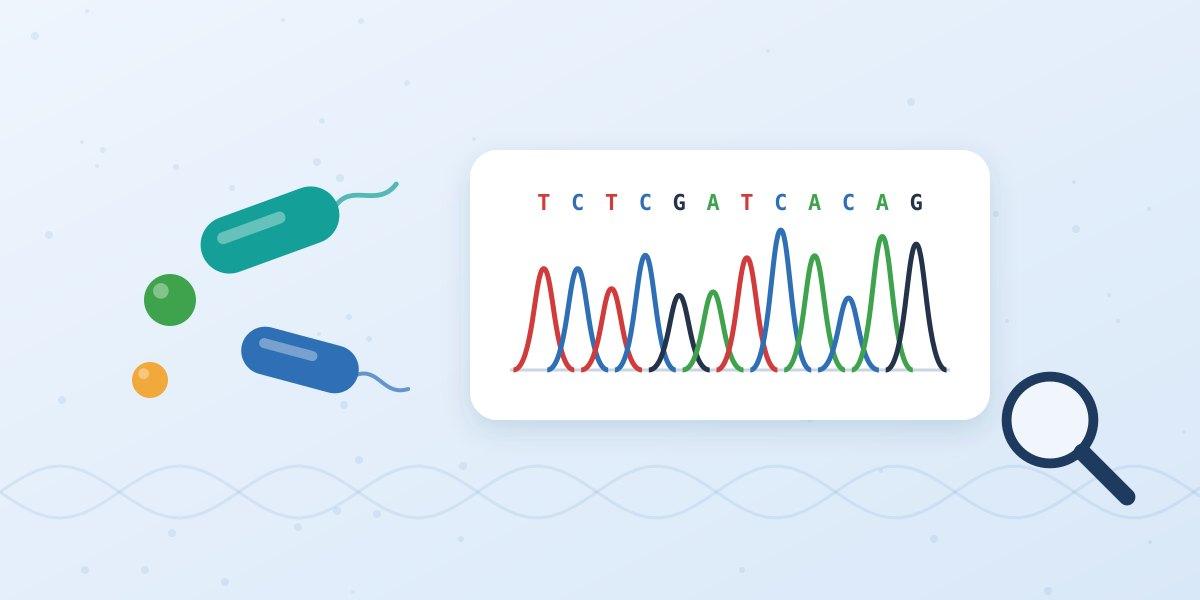
You have a bacterial isolate — from soil, water, food, a probiotic product, a fermentation tank or a clinical-research sample — and you need to know what it is. Biochemical tests give you a shortlist; a reviewer or a QC auditor wants a molecular identification and, very often, a GenBank accession number. The standard way to get both is 16S rRNA gene sequencing.
This guide explains how 16S rRNA sequencing identifies bacteria, what sample to send, how to read the result, how to get your sequence into GenBank, and what it costs in India. At Yaazh Xenomics, 16S rRNA sequencing for bacterial identification is ₹3,200 per sample (GST extra) with a 3–5 day turnaround from sample receipt, and we can collect samples from anywhere in India.
What is 16S rRNA gene sequencing?
Every bacterium carries the 16S rRNA gene, which codes for part of the small (30S) subunit of the ribosome. Because the ribosome is essential, the gene is present in all bacteria and much of it is highly conserved — yet it also contains variable regions that differ from one group of bacteria to another. Those variable stretches act like a fingerprint for identification.
The conserved ends of the gene let us use universal primers. The classic pair, 27F and 1492R, binds near the two ends of the 16S gene and amplifies almost the whole gene (an amplicon of roughly 1,400–1,500 bp). Sequencing that amplicon from both directions gives a long, high-quality read that can be matched against tens of thousands of reference sequences.
Compared with conventional identification (morphology, staining, growth on selective media and biochemical panels), 16S sequencing is faster, less subjective, and works for organisms that are slow-growing or behave atypically in biochemical tests.
16S identification vs 16S metagenomics — which one do you need?
The same gene is used for two very different questions, and labs often ask for the wrong one. Use this table to choose:
| 16S rRNA sequencing (identification) | 16S rRNA metagenomics | |
|---|---|---|
| Question | What is this one isolate? | Which bacteria are in this whole sample, and in what proportion? |
| Sample | Pure culture, gDNA or PCR product from a single isolate | Soil, water, gut/stool, food, sludge — mixed communities |
| Technology | Sanger sequencing of the (near) full-length gene | NGS of one or more variable regions (e.g. V3–V4) or full-length long reads |
| What you get | One consensus sequence + species/genus identification | Community profile, diversity indices, relative abundance charts |
| Yaazh Xenomics price | ₹3,200 per sample | 16S metagenome V3–V4 or V1–V9 |
If you need the community view, read our guide to 16S rRNA sequencing and metagenomics. The rest of this article is about identifying single isolates.
How 16S rRNA identification works at Yaazh Xenomics
- Sample receipt and logging. Each sample is checked against your sample sheet (name, sample type and medium).
- DNA extraction from your culture — skipped if you send genomic DNA or a PCR product.
- PCR amplification of the 16S rRNA gene with universal bacterial primers.
- Quality control of the amplicon on agarose gel and by spectrophotometry, followed by clean-up.
- Bidirectional Sanger sequencing — forward and reverse reads on ABI capillary instruments with standard terminator chemistry.
- Consensus assembly and trimming — low-quality ends are removed and the two reads are merged into one high-confidence sequence.
- Identification — the consensus is compared against reference databases (BLAST) and the closest matches are reported with percentage identity and query coverage. A phylogenetic tree is included with every identification.
You place the order online in our Store or request a quote for larger batches, then track every sample in your client portal and download the report there.
What sample should you send?
A pure culture is essential. A mixed culture produces overlapping signals in Sanger sequencing and an unreadable chromatogram, so streak to a single colony before sending. A fresh, actively growing culture usually gives the best DNA.
| Sample type | Medium / format | Tips |
|---|---|---|
| Culture | Agar plate | Seal the plate with parafilm; label the colony to be sequenced if several are present. |
| Culture | Slant | Tight cap; avoid very old, dried slants. |
| Culture | Broth | Leak-proof screw-cap tube; send promptly after growth. |
| Culture | Glycerol stock | Ship cold; tell us the storage conditions. |
| DNA | Genomic DNA | Share the concentration and how it was extracted; we QC before sequencing. |
| DNA | 16S PCR product | Send the primers used. If you only need sequencing of your own PCR product, our bidirectional PCR product sequencing (₹700/sample, purified at 10–50 ng/µl) is the cheaper route. |
When you order online, the sample sheet asks for exactly these details — sample name, sample type (Culture, Tissue, Plant or DNA), sample medium (Agar plate, Slant, Broth or In ethanol) and any remarks. Need us to collect the samples? See sample pickup.
How to read your 16S result
Your report lists the closest reference sequences with two numbers that matter: percentage identity (how similar your sequence is) and query coverage (how much of your sequence aligned). Here is how microbiologists usually interpret them:
| 16S identity to the closest type strain | Typical interpretation |
|---|---|
| ≥ 98.65 % (with high coverage) | Very likely the same species — this is the threshold proposed by Kim et al. (2014) after comparing 16S similarity with whole-genome average nucleotide identity. |
| ~97 – 98.65 % | Same genus is likely; species assignment is uncertain and needs more evidence. |
| < 97 % | Possibly a different genus or a novel taxon — worth further characterisation. |
When 16S is not enough, bacterial whole genome sequencing on Illumina (₹18,500 per sample) gives species- and strain-level resolution plus antimicrobial-resistance and virulence genes. Our guide to short-read vs long-read bacterial WGS explains the options.
Getting a GenBank accession number for your thesis or paper
Most journals and many universities expect new sequences to be deposited in a public database, and the accession number is quoted in the methods section. The consensus FASTA we deliver is ready to upload:
- Sign in at NCBI submissions and start an rRNA (16S) submission — NCBI provides a dedicated wizard for prokaryotic 16S sequences from cultured isolates.
- Upload the consensus FASTA, and add the organism name from your identification, the strain/isolate name and the isolation source.
- Choose whether to release the sequence immediately or keep it confidential until your paper is published.
- NCBI emails your accession number, usually within two working days.
Tip: keep the original chromatogram files (.ab1) with your lab records — reviewers occasionally ask for them. They are included with every result we send.
16S rRNA sequencing price in India (2026)
Our published per-sample prices for identification-type sequencing (GST extra):
| Service | Use it for | Price per sample | Turnaround |
|---|---|---|---|
| 16S rRNA sequencing – bacterial identification | Bacteria and actinomycetes | ₹3,200 | 3–5 days |
| 18S rRNA sequencing | Fungi, yeast, algae | ₹3,200 | 3–5 days |
| ITS sequencing | Species-level fungal ID (the fungal barcode) | ₹3,200 | 3–5 days |
| Bidirectional PCR product sequencing | You already have a purified 16S PCR product | ₹700 | 1–3 days |
| Bacterial whole genome (Illumina) | When 16S cannot separate close species | ₹18,500 | 2–4 weeks |
Academic and bulk pricing is available for batches of isolates — request a quote with the number of samples and we will send a price to review in your portal.
Order 16S rRNA sequencing online
Frequently asked questions
How long does 16S rRNA sequencing take?
Our standard turnaround is 3–5 days from the day we receive your sample, including DNA extraction, PCR, sequencing and identification. You can follow each sample's progress in your client portal.
Can 16S rRNA sequencing identify bacteria to species level?
Often, yes — a match of about 98.65 % or higher to a type strain, with high coverage, usually indicates the same species. For closely related groups with near-identical 16S genes, the result may only be reliable to genus level, and whole genome sequencing is recommended.
Do I need to extract DNA before sending?
No. Send a pure culture on an agar plate, slant, in broth or as a glycerol stock and we will extract the DNA. If you prefer, you can send genomic DNA or your own 16S PCR product instead.
Can you identify fungi, yeast or algae?
Yes, but with a different marker: use ITS sequencing for species-level fungal identification or 18S rRNA sequencing for broader fungal and algal identification. Insects and tissues use the COI gene, and plants use rbcL.
What if my culture is mixed?
Mixed cultures give overlapping Sanger traces that cannot be read. Re-streak to a single colony first. If you actually want to know everything in a mixed sample, choose 16S metagenomics instead.
Do you collect samples from outside Coimbatore?
Yes — we arrange sample pickup across India. See sample pickup or mention it when you place the order.
Ready to identify your isolates?
Order online in minutes — choose 16S rRNA sequencing, enter your sample names, type and medium, and pay now or later. For larger projects, request a quote or call us on +91 99431 32020.
Request a quote for multiple isolates
References
- Kim M, Oh H-S, Park S-C, Chun J. Towards a taxonomic coherence between average nucleotide identity and 16S rRNA gene sequence similarity for species demarcation of prokaryotes. Int J Syst Evol Microbiol 2014;64:346–351. doi:10.1099/ijs.0.059774-0
- Weisburg WG, Barns SM, Pelletier DA, Lane DJ. 16S ribosomal DNA amplification for phylogenetic study. J Bacteriol 1991;173(2):697–703.
- Woo PC, Lau SK, Teng JL, Tse H, Yuen KY. Then and now: use of 16S rDNA gene sequencing for bacterial identification and discovery of novel bacteria in clinical microbiology laboratories. Clin Microbiol Infect 2008;14(10):908–934.
- NCBI. How to submit data to GenBank.
Planning a sequencing project?
Get a tailored quote — our team replies within one business day.
Request a quote