
Who Should Get Whole Exome Sequencing? Indications for Early Diagnosis in India
By Dr. Suresh Lingam, PhD · · 6 min read

Many genetic disorders start in infancy or childhood, but families often spend years moving from specialist to specialist and test to test before they get a name for the condition. Whole exome sequencing reads the protein-coding part of about 19,400 genes in one test, where most known disease-causing variants are found. Used early, it can shorten this "diagnostic odyssey", guide treatment and monitoring, and tell parents the chance of the condition happening again.
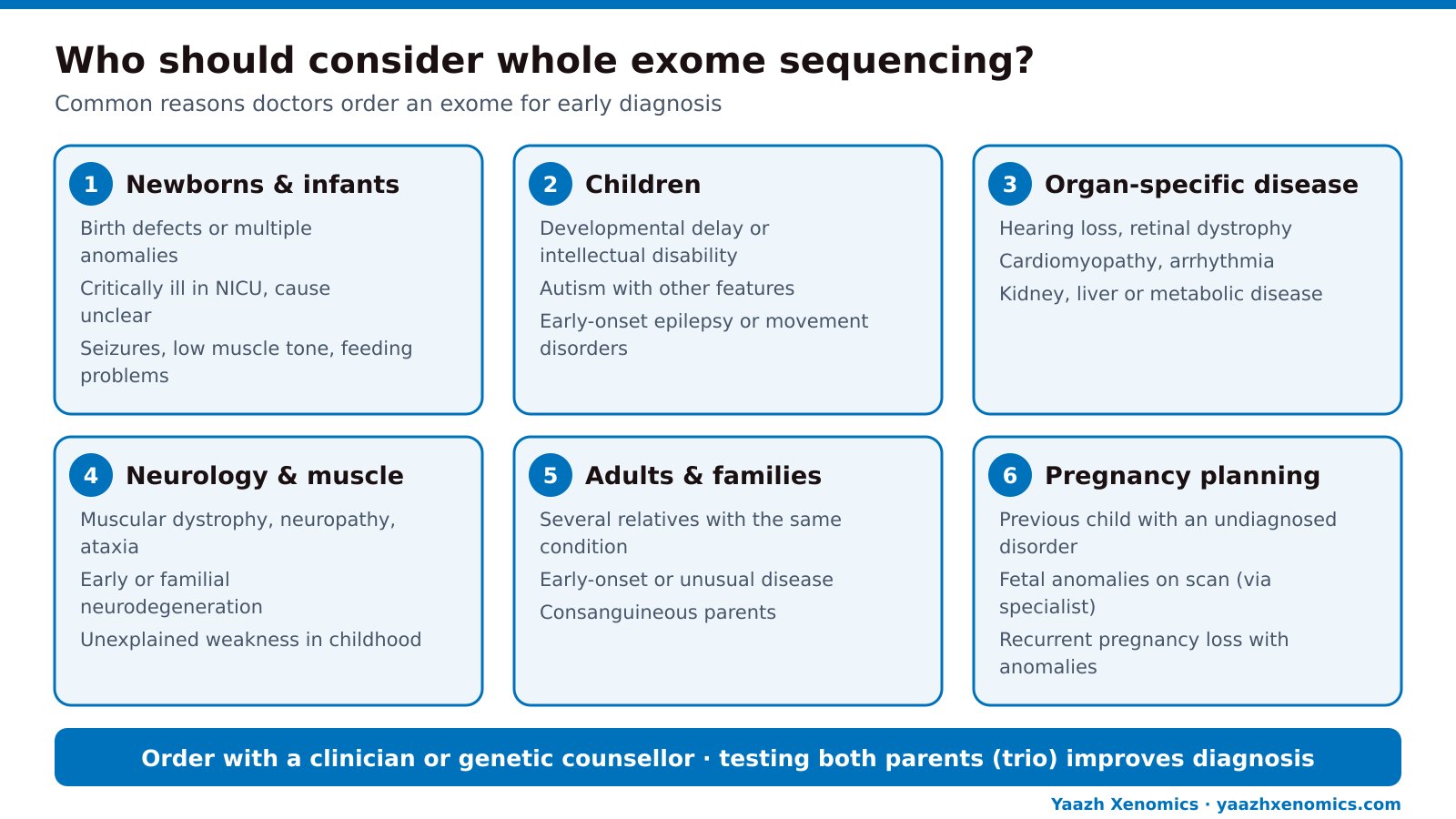
Who should consider whole exome sequencing?
Newborns and infants
- One or more birth defects (congenital anomalies), especially in more than one organ
- A critically ill baby in the NICU whose illness has no clear cause
- Seizures, very low muscle tone (hypotonia) or feeding difficulty from early life
Children
- Developmental delay or intellectual disability
- Autism with additional features such as birth defects, unusual growth or seizures
- Early-onset epilepsy or movement disorders
- Short stature or skeletal problems that suggest a skeletal dysplasia
Nerve and muscle disorders
- Muscular dystrophies and congenital myopathies
- Inherited neuropathies (for example Charcot-Marie-Tooth disease), ataxias and hereditary spastic paraplegia
- Early-onset or familial neurodegenerative disease
Eye, ear, heart, kidney, immune and metabolic disease
- Inherited retinal dystrophy (such as retinitis pigmentosa) and congenital cataract
- Hearing loss present from birth or childhood
- Cardiomyopathy, inherited arrhythmia or sudden cardiac death in a young relative
- Cystic kidney disease, glomerular disease or kidney malformations
- Suspected inborn errors of metabolism
- Primary immunodeficiency (repeated severe infections)
Adults
- A condition that began unusually early
- The same condition in several relatives
- A disorder that remains unexplained after standard investigations
Families and pregnancy planning
- Couples who had a child or pregnancy with an undiagnosed genetic disorder
- Consanguineous couples with an affected relative, since recessive disorders are more common when parents are related
- Pregnancies with structural anomalies on ultrasound after a normal karyotype or microarray, ordered through a fetal medicine specialist
Why test both parents? The trio exome
In a trio exome, the affected person and both parents are sequenced together. This shows straight away whether a variant is new in the child (de novo), which is common in developmental disorders, or inherited, and it confirms recessive inheritance when each parent carries one copy. Trio analysis usually gives a higher diagnostic rate than testing the patient alone and speeds up interpretation. At Yaazh Xenomics each person is sequenced at the per-sample price.
Exome, gene panel or genome?
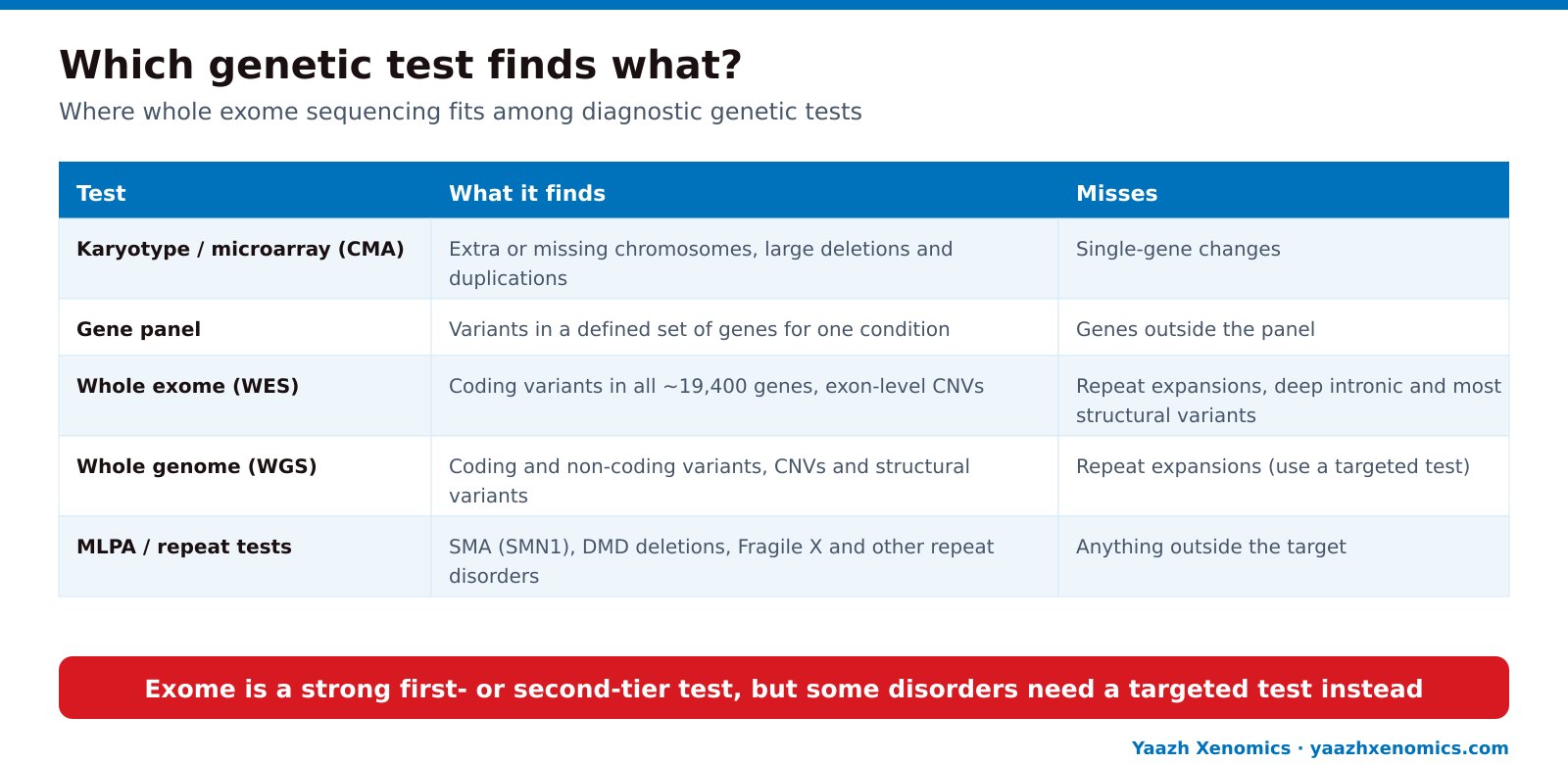
| Situation | Usually the better first test |
|---|---|
| Condition points to a known group of genes (for example hereditary breast cancer) | Gene panel, from ₹12,999 |
| Many possible genes or no clear diagnosis | Whole exome sequencing, ₹14,999 |
| Exome negative, or structural and non-coding variants suspected | Whole genome sequencing, ₹75,000 |
| Suspected chromosomal disorder | Karyotype or chromosomal microarray |
| Suspected Fragile X, myotonic dystrophy, Huntington disease or SMA | Targeted repeat test or MLPA |
What exome sequencing cannot detect
An exome is powerful but not complete. It does not reliably detect repeat-expansion disorders (Fragile X syndrome, myotonic dystrophy, Huntington disease), spinal muscular atrophy caused by SMN1 deletion, chromosomal aneuploidies, mitochondrial DNA variants, deep intronic changes or most large structural variants. Some exon deletions, for example in the DMD gene, are best confirmed by MLPA. A negative exome therefore does not rule out a genetic cause, and the data can be reanalysed later as new disease genes are discovered.
How to get exome sequencing in India
- See a doctor or genetic counsellor, who will confirm that an exome is the right test and explain possible results, including secondary findings.
- Send the sample: 5 ml of blood in an EDTA tube from the patient (and both parents for a trio), with a short clinical summary. We arrange pickup from anywhere in India.
- Sequencing and analysis: 19,433 genes at 100X on the Illumina NovaSeq X, with variant calling and classification using ACMG/AMP guidelines.
- Report in 3 weeks, to be discussed with your doctor, who can arrange treatment, monitoring and testing of relatives.
Germline WES costs ₹14,999 per sample and somatic tumour exome ₹28,500 (GST extra). Hospitals and clinicians can refer patients through our clinical partners page. This article is for general education and does not replace medical advice.
Frequently asked questions
Who should get whole exome sequencing?
Babies with birth defects or unexplained critical illness, children with developmental delay, intellectual disability or early-onset epilepsy, and children or adults with inherited nerve, muscle, eye, ear, heart, kidney or metabolic disorders. It is also used by families who have had a child with an undiagnosed disorder.
At what age can exome sequencing be done?
At any age, from newborns to adults, because it uses DNA from a blood sample. For babies and children it is most useful early, before many other tests have been done.
How accurate is exome sequencing for diagnosis?
Published studies find a genetic diagnosis in roughly a quarter to a third or more of patients, depending on the condition and whether parents are tested; yields are higher for some groups such as retinal dystrophies and lower for others. Trio testing usually improves the rate.
Can exome sequencing find problems unrelated to my condition?
Yes. Exome data can show variants in medically actionable genes unrelated to the reason for testing, called secondary findings. You can choose before testing whether to receive or decline these findings; discuss the choice with your doctor.
How much does whole exome sequencing cost in India?
At Yaazh Xenomics germline WES costs ₹14,999 per sample and somatic WES ₹28,500, plus GST, with a report in 3 weeks. See whole exome sequencing cost in India for a full comparison.
Planning a sequencing project?
Get a tailored quote — our team replies within one business day.
Request a quote