
Who Should Get Whole Genome Sequencing? WGS vs Exome for Diagnosis in India
By Dr. Suresh Lingam, PhD · · 6 min read

A whole exome reads the protein-coding 1–2% of the genome, where most known disease-causing variants sit. A whole genome reads all 3.2 billion base pairs. That extra coverage matters when the cause of a disease lies outside the exons or in a large rearrangement that exome capture cannot read well.
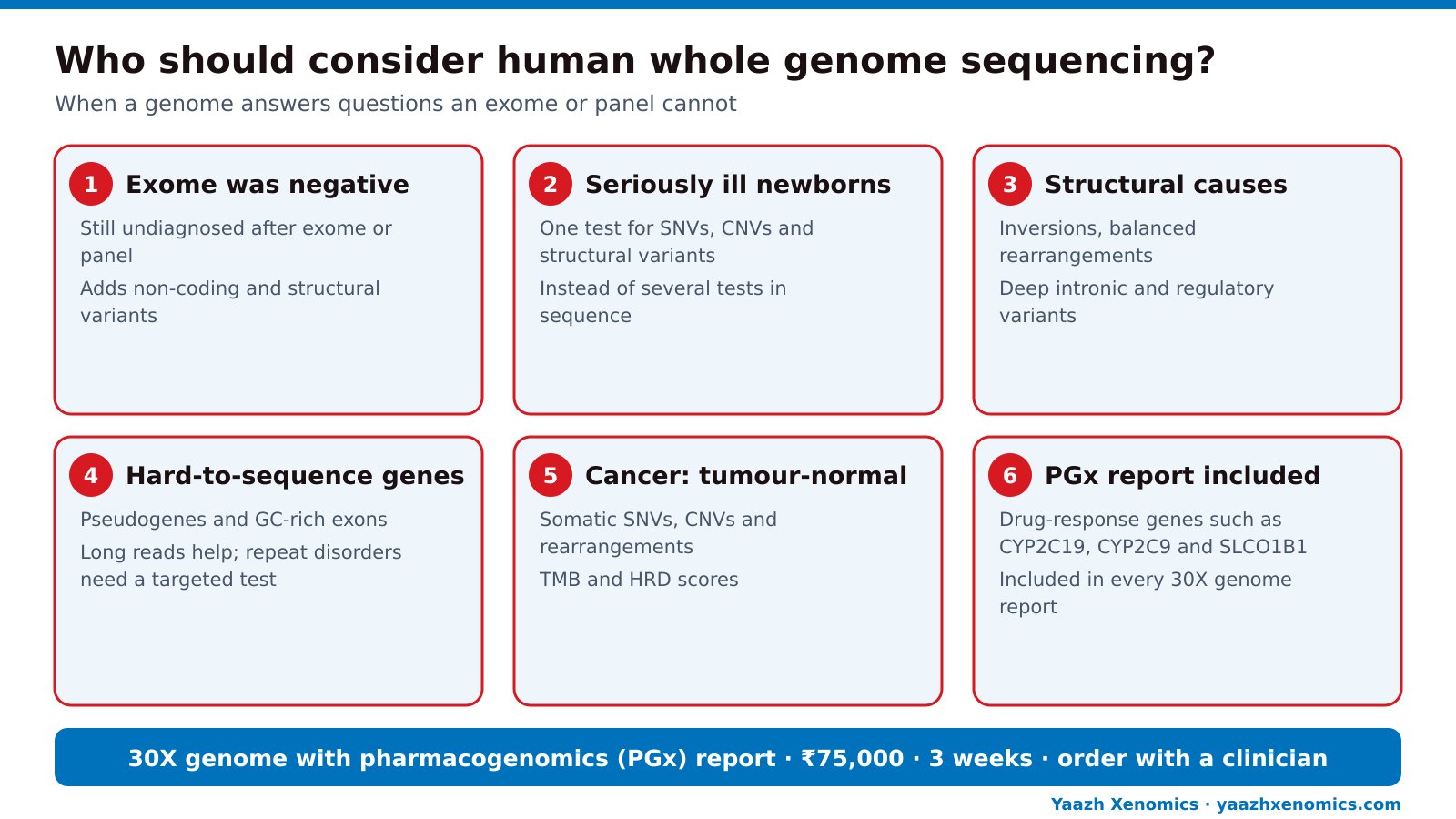
Who should consider whole genome sequencing?
Patients still undiagnosed after an exome or panel
Genome sequencing adds deep intronic and regulatory variants, copy-number changes and structural variants. In a large rare-disease study published in the New England Journal of Medicine in 2024, about 8% of families had a diagnosis that needed genome sequencing to find, including intronic variants, structural variants, inversions and tandem repeat expansions. The same study found that many diagnoses after a negative exome came from reanalysing the exome data, so reanalysis is a sensible first step; we can do both.
Seriously ill newborns and children
For a baby with an unexplained serious illness, one genome can replace a microarray, an exome and other tests done one after another. Randomised and multi-centre studies of rapid genome sequencing in intensive care found that results changed medical management in roughly a quarter to a third of the infants tested. Our turnaround is 3 weeks for all samples.
Suspected structural or non-coding disorders
- Balanced translocations, inversions and complex chromosomal rearrangements
- Splicing and regulatory variants outside the coding sequence
- Repeat-expansion disorders such as Fragile X syndrome, myotonic dystrophy and Huntington disease still need a targeted repeat test
- Genes with pseudogenes or GC-rich exons, where Oxford Nanopore long reads help
Cancer: tumour-normal genome sequencing
Sequencing a tumour alongside the patient's normal blood finds somatic single-nucleotide variants, copy-number changes and rearrangements across the whole genome and gives tumour mutational burden (TMB) and homologous recombination deficiency (HRD) scores.
Pharmacogenomics (PGx) report included
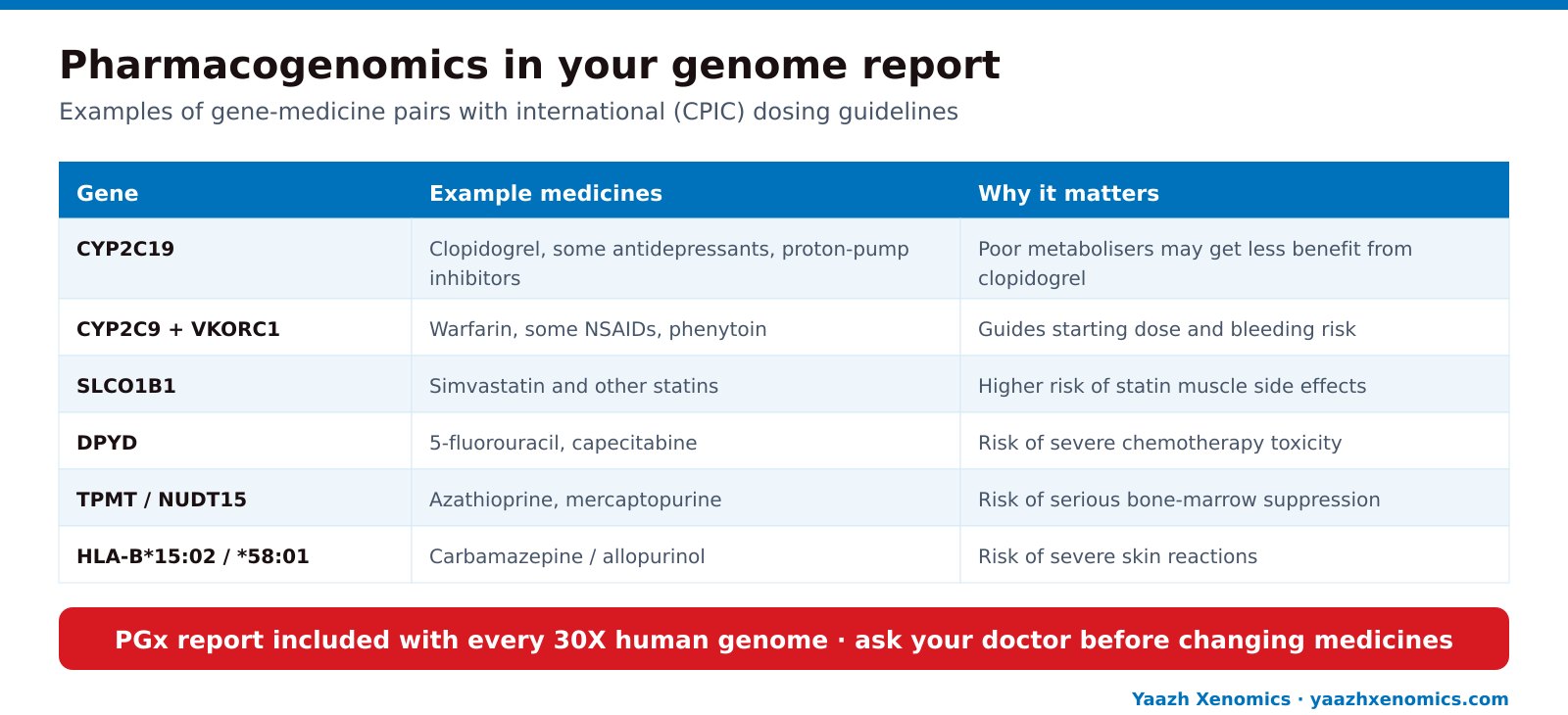
- CYP2C19: clopidogrel, some antidepressants and proton-pump inhibitors
- CYP2C9 and VKORC1: warfarin dosing
- SLCO1B1: muscle side effects with simvastatin and other statins
- DPYD: severe toxicity with 5-fluorouracil and capecitabine
- TPMT and NUDT15: bone-marrow suppression with azathioprine and mercaptopurine
- HLA-B: severe skin reactions with carbamazepine and allopurinol
Your genome does not change, so these results stay useful for life and can be shared with any doctor who prescribes for you. The genes analysed are listed in your report. Never start, stop or change a medicine on the basis of a genetic result without speaking to your doctor. Genome data is also widely used for population and cohort research.
Whole genome vs whole exome vs gene panel
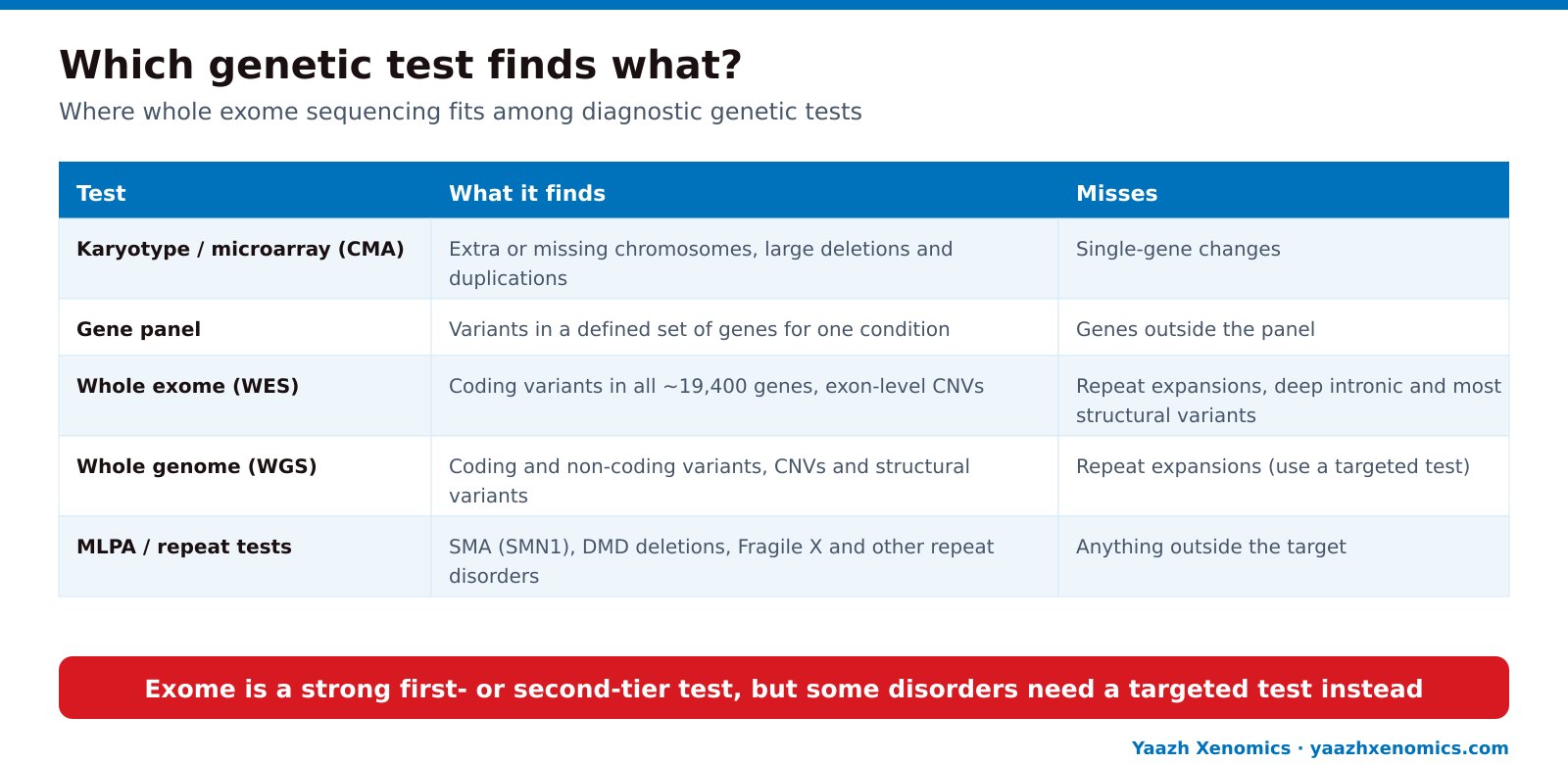
| Gene panel | Whole exome | Whole genome | |
|---|---|---|---|
| What it reads | A defined set of genes | Coding regions of ~19,400 genes | The entire genome |
| Finds structural and non-coding variants | No | Limited | Yes |
| Best for | A clear clinical suspicion | First genome-wide test | Negative exome, structural or non-coding cause, critically ill infants |
| Price at Yaazh (GST extra) | From ₹12,999 | ₹14,999 (100X) | ₹75,000 (30X) |
| Turnaround | 3 weeks | 3 weeks | 3 weeks |
How to get whole genome sequencing in India
- See a doctor or genetic counsellor, who will decide whether a genome, exome or panel is the right test and explain possible results, including secondary findings you can choose to receive or decline.
- Send the sample: 5 ml of blood in an EDTA tube per person (and from both parents for a trio), with a short clinical summary. We arrange pickup from anywhere in India.
- Sequencing and analysis: 30X (100 Gb) on the Illumina NovaSeq X, alignment to GRCh38, and detection of SNVs, indels, CNVs and structural variants, classified using ACMG/AMP guidelines.
- Report in 3 weeks, including a pharmacogenomics section, to discuss with your doctor.
Already have genome data from another provider? Send FASTQ, BAM or CRAM files and our human genome analysis takes 4–6 days. For coding-only questions, see who should get whole exome sequencing. This article is for general education and does not replace medical advice.
Frequently asked questions
Is whole genome sequencing better than an exome?
It detects more types of variants, but it costs more and most diagnoses are coding variants that an exome also finds. An exome is often the first test; a genome is preferred after a negative exome or when structural or non-coding causes are suspected, and it includes a pharmacogenomics report.
How much does human whole genome sequencing cost in India?
At Yaazh Xenomics a 30X human genome costs ₹75,000 plus GST, with a clinical and pharmacogenomics report in 3 weeks. See our human whole genome sequencing cost guide.
Can a genome show my response to medicines?
Yes. Our report includes a pharmacogenomics section based on genes such as the CYP450 family that affect how medicines are processed. Any change to treatment should be made by your doctor.
Is my genome data kept confidential?
Yes. Samples are coded with unique identifiers and results and data are shared only with you and your ordering clinician.
What does 30X coverage mean?
Each position in the genome is read about 30 times on average, the standard depth for detecting inherited variants accurately.
How long does whole genome sequencing take?
3 weeks from sample receipt for all samples, including the clinical report and the pharmacogenomics report.
Is a pharmacogenomics report included with whole genome sequencing?
Yes. Every 30X genome report from Yaazh Xenomics includes a pharmacogenomics (PGx) section at no extra cost.
Can children and newborns have whole genome sequencing?
Yes. It uses a blood sample and can be done at any age; it is arranged by the treating doctor for babies and children with unexplained illness, birth defects or developmental delay.
Planning a sequencing project?
Get a tailored quote — our team replies within one business day.
Request a quote